

The logic of extraction
A theory of why life feels so off the rails

While in London for work last week, I ate a kale chicken caesar salad that cost £13 and suspiciously claimed to have 50 grams of protein in it. This kind of “meal size” salad is something that, as an American in the UK, I’ve historically complained was not available. In fact, the place I bought it from was exactly like the kind of place you might find in San Francisco: high concept biodegradable packaging, a minimalist brand identity with an AI-generated name, and vast shelving space from which underpaid delivery drivers can pick up these large salads. The salad was healthy and filling but also made me feel oddly melancholic while I sat outside and ate it.
After the salad, I walked up Tottenham Court Road and turned right on Euston Road to head to Kings Cross to catch my train home. As I walked, I noticed the homeless encampment across from the big hospital. I had already clocked an uptick in the last year or so in the amount of unhoused people in London, but a fully-established encampment like this is something you never used to see here. Just like that salad, it reminded me of something you might see in San Francisco. Huh.
There are so many fucked up things happening in our world right now, I find it near paralyzing to figure out which one to write about — or indeed whether to write at all. But I’ve increasingly been thinking about everything that’s happening through a unifying framework, one that seems to be rapidly accelerating before our eyes: the logic of extraction.
Extraction isn’t my idea; it’s the operating logic of private equity which, by some estimates, controls as much as 20% of the US economy.1 The general gist is that everything in our world is driven by the impulse to extract power and wealth from one set of people or resources and move it further up the chain. The higher up the chain it goes, the more detached from reality it becomes. The further down, the sadder and more desperate.
Take that salad: At the bottom of the chain are the delivery drivers who are summoned via app to fetch the salad for a person like me, who for some reason believes they need to consume 50g of protein at lunch to work a laptop job. My £13 goes to the (also probably) underpaid person assembling my salad, then eventually up to the founders of the scalable salad brand. They are, of course, at the whim of their venture capital investors2, who have provided millions of pounds of investment in order for the salads to one day be available in every borough of London, and then, presumably, across Europe. So you can get a San Francisco-style salad in Paris instead of eating carbs.
Eventually, once sufficient scale has been reached, the investors will want more value out of the whole chain, and the logic of extraction will start to become visible to you and me. Because quality, nutrition, or a salad as a part of a ruthlessly optimized lifestyle was never really the point here. Extraction at scale was. The quality and protein content will drop, the salads will get more expensive, the workers more pissed off at entitled people like me, and the delivery drivers even more squeezed. Everyone, at some point in the chain, is extracting marginally decreasing value from one another.
No wonder I felt vaguely sad while eating it.
***
Extraction is all pretty straightforward when you’re thinking about consumer-facing brands that cater to millennials and Gen-Z. Or indeed, tech platforms — see Cory Doctorow’s similar theory of enshittification. But I’m beginning to see this logic everywhere I look: the homeless encampments, forced regime change in oil-rich countries, elite sex trafficking rings, ICE raids, the hyper-manipulated bodies and faces of female celebrities who appear on red carpets looking almost tranquillized.
To pick one of those examples: the widespread vile behaviour detailed in the Epstein files. I think this story has demonstrated such staying power because it’s hard to deny that it reveals a feature of how power works, not a bug. Because a lot of people saw a relationship with Epstein as a way to extract value, wealth, and/or access to power for their own ends. They extracted it at the expense of vulnerable girls and women — either by directly participating in their abuse and exploitation or by tolerating the plainly intolerable. Epstein moved up the chain and got ever richer as well as more insulated from accountability; his chums got whatever it was they wanted — funding, sex, invitations to weird private islands, connections to other rich people; and the women got abused.
As detailed in Andrew Lownie’s forensically-reported book, Andrew Mountbatten-Windsor’s entire raison d’etre has has been figuring out ever more inventive ways to extract value out of a system — funded by the UK taxpayer — seemingly to deal with the trauma of his childhood and having no real purpose in an outdated monarchy. That monarchy, of course, is an OG model of extraction on a global scale. From the scale of the family to the scale of empire, it’s extraction all the way down.
I sense we’re at a point where the logic of extraction has gone so far, so off the rails, that it’s actually embedded into a lot of people’s consciousness. And it’s making everyday life feel bizarre and upside down in that uncanny £13 salads and homeless encampments kind of way.
I first wrote about my own collapse awareness in 2024, and that’s exactly what this is symptomatic of. It’s not the end of humankind, it’s the long tail of a system of extraction that most of us have been living under, even if we didn’t realize it. But in the last year, things have sped up to a dizzying velocity, which is why it’s feeling harder to sustain the fiction of our normal day-to-day lives. It’s harder to pretend that we can course correct from all this and be still living in a world that’s recognizable.
As Douglas Rushkoff wrote in a post that explains extraction very well: “[The] pyramid simply grew too top heavy to support itself. There’s only so much you can leverage up there before it comes tumbling down.”
Sitting at the tippy top of the top-heavy system is the conversation around AI. On my train home from London, I read a viral piece on Substack called “The 2028 Global Intelligence Crisis” which lays out a hyperreal and totally believable scenario for what might play out in the global economy in the next two to three years3. It felt so real, in fact, that it moved markets and spurred a selloff of tech stocks last week. Funnily enough, it talked a lot about the kinds of delivery apps that are integral to the business model of the place I bought that salad.
Pretty soon, the authors imagined, using AI becomes cheaper and more efficient than employing a white collar workforce. They estimated that workforce represents 50% of employment in the US, and in turn, 75% of discretionary consumer spending. That presents a problem: “The businesses and jobs that AI was chewing up were not tangential to the US economy, they were the US economy.”
And so, you get a situation where a few very rich men at the top have extracted most of the value out of our economy and into their portfolios, while the white collar folks have no jobs, and thus can’t pay for the mortgages and restaurant meals and home improvements and cleaners that the rest of the economy is built on. As goes the US economy, so goes the world.
I’m sorry if I sound alarmist. This is just a thought experiment and there are all kinds of variables that could prove it off base. But I find it notable that these authors caused such a ruckus simply by plainly articulating what the logical end point of this extractive system is. This really isn’t some big plot twist. If you’ve worked in any creative industry for the last two decades, this dynamic has probably already happened to you several times over. Now it’s just threatening to happen to everyone else.
But how could they do this, you ask? Won’t someone stop them? Maybe, but I mean, have you taken a look at the state of Congress recently? And if you only think through the frame of extraction, as the men in power in our world do, following things to this (il)logical end point makes perfect sense.
As Sam Kriss wrote in this incredibly well observed snapshot of the “high agency” men of Silicon Valley, the end goal is the only goal. They are not founding companies because they have a great idea or want to change the world anymore. They are founding companies to extract value. There is nothing — government regulations, morality, consequences, self control — to stop them, so why on earth would they stop? Creating a nourishing salad (or a liveable world) was never really the goal anyway.
Of course, if you believe in the reality of other things like the joy of process, the dignity of all human beings (not just high agency ones), and an embodied experience of being alive, then this logic makes NO sense. Why would you pursue an end goal if it causes so much suffering and misery when it’s finally achieved? And that is, I think, why we all feel so insane and unmoored in this moment. Forget the governments we vote for every few years — our world is actually run by the logic of extraction, which is great at generating monetary value and channeling it to the top of the chain, but terrible for human flourishing.
***
After my two days in London, I came home and told my husband I felt like the crazy board guy meme. (Perhaps I sound like him too.) Everything is connected, everything is fucked, what the fuck am I supposed to do?
My intense and sensitive brain does this periodically, and the deep focus required to write a book doesn’t help. I know when I start thinking this way, I need to stop thinking at all. Laptop off limits. Apps deleted from phone. Luckily, a weekend with my 3.5 year old leaves scant time for thinking or scrolling.
So I took my son to a playdate at his friend’s house, where we had lunch and I made small talk with his friend’s mom. Later that day, I had my friend’s two kids over in the afternoon because she desperately needed to rest. I told her that she was categorically banned from doing anything for anyone but herself while her kids were at my house.
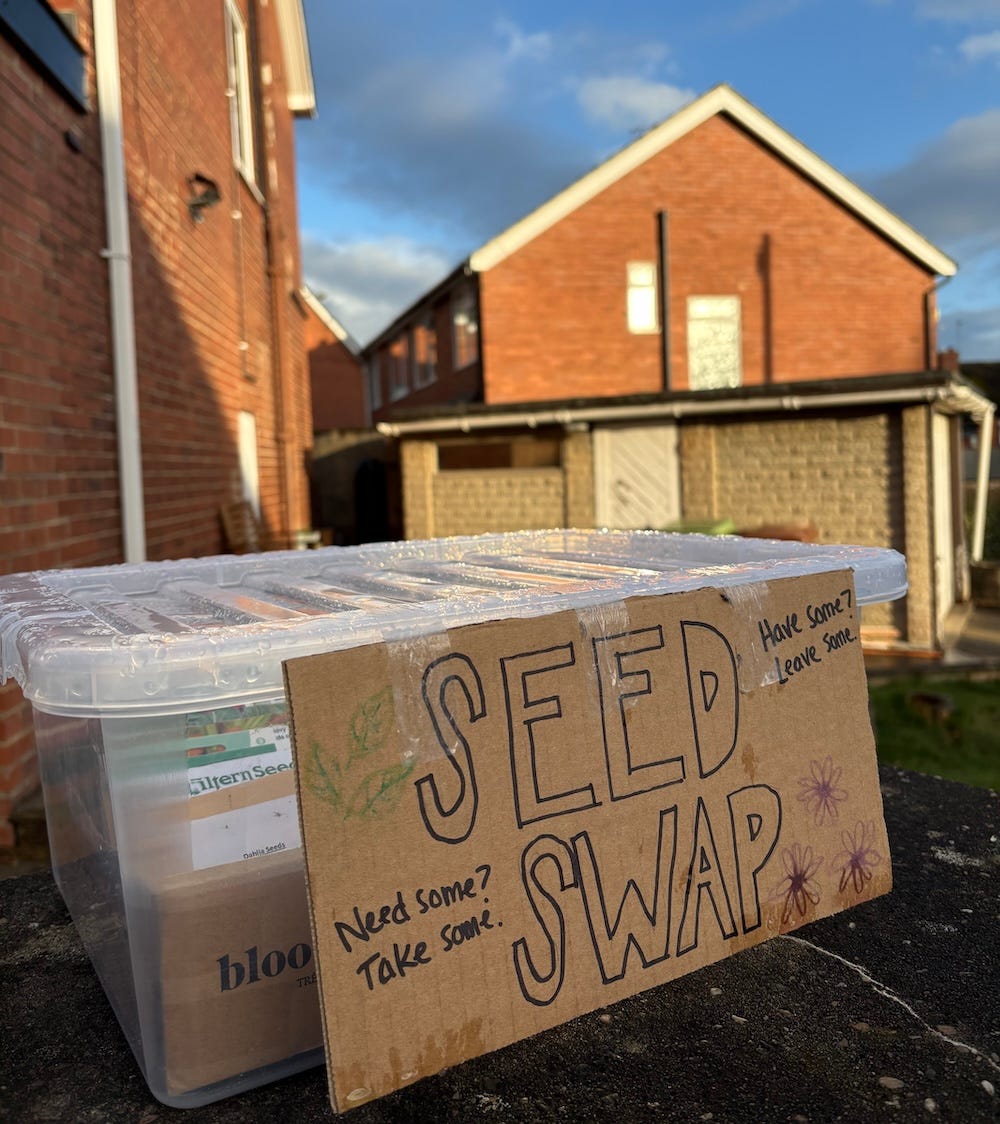
I organized a very informal seed swap using my neighbourhood group chat, and my son and I sowed some kale and chard seeds that germinated on my windowsill five days later. We talked about the daffodils and the almond tree blossoming in front of our house. The next morning he ran to the back window to report a “very exciting thing outside”: Another daffodil had bloomed. Yes, I told him, it’s March 1 now. Spring is finally here.
At some point towards the end of the weekend, I thought about how, should the AI 2028 scenario come to pass, my weekend could have looked largely the same. (Maybe minus watching Love is Blind.) That’s because I spent the weekend doing a bunch of things that mostly exist outside of this system of extraction. Of course, most of them had to do with care, because that’s the one thing the economy steadfastly refuses to see any real value in.
You might balk at the idea of my pleasant-sounding weekend being framed in this semi-radical way, but I’m increasingly unapologetic about seeing it that way. Several news cycles ago, when we were all talking about the ICE raids in Minneapolis instead of the escalating war in Iran, I was struck by a line from a Minneapolis resident in this deeply reported New York Times Magazine piece: “I’ve been telling people, if you want to really be prepared for stuff like this that’s going on in Minneapolis right now, you need to know your neighbors.”
In other words, these horizontal networks and patterns of mutuality don’t pop up out of nowhere. You have to build the groundwork before you actually need them. You have to stop believing in the logic of extraction for long enough in your week to invest your time and energy into building something else.
When it all gets too much, I think about stuff like this: When someone plants a packet of those seeds in the coming weeks, the flowers will bloom and sustain the pollinators over the growing season. Or, they might eat the vegetables they grow and buy less stuff from the grocery store as a result. Then, if that person chooses to save the seeds from the spent plants at the end of the season, they’ll be able to grow another year of plants without spending any money at all, or trade them with a neighbor to grow something else. That right there is the opposite of extraction. It’s regeneration. It sounds poetic and kind of cliche, but it’s also entirely literal. We cannot lose sight of the fact that this is the way things are designed to work.
This is the work of our moment, I believe. Not saving seeds, but to find ways to circumvent this logic even while we still have to exist under it. This has been the message I’ve been writing about, in various ways, for several years now. It’s what my book is about. No one is going to do it for us, though. The top of the chain doesn’t even believe an alternative exists. But I do.
Thank you for reading. All of my writing here is offered free to all readers, but if you want to support my work further, the cheapest way is to do that is to upgrade to an annual paid subscription here. Thanks to those of you who already pay to support my work — it gives me the time, childcare, and headspace to write essays like this one.
See this great piece which clearly lays out everything that PE touches, and helped inspire my thinking here.
Like private equity, but for startups rather than mature companies.
H/t to my former colleague and fellow Substacker Jenny Anderson for bringing this piece to my attention over coffee in London!
Yes, regeneration is exactly how this should work. Regeneration is a core property of all living systems, and extraction is the logic of cancer. We may not feel we have many choices in this system, but we really do have more choices than many of us realize, across many dimensions of our lives. Thank you for writing this with such clarity.
YES! Thank you! I was walking around earlier this week thinking about how all I want is to do real, embodied things (cook with real ingredients, care for my kids, make art, read books, spend time with friends, take care of my neighbors - can't that be enough for a whole life?) and almost chided myself for being so "radical" and then realized, "hey, living the way we did *forever* as humans is not radical!" The constant extraction via private equity, enshittification (I'm in the middle of that book right now, it's excellent), and all other modes of being/thinking/feeling inherent in late stage capitalism are literally just ideas and we can reject them. Now, we've of course all been hypnotized for decades to accept things the way they are (wealth supremacy, meritocracy, financialization, etc.) so...easier said than done... but still, I think we're in a turning point of consciousness (as your essay so beautifully and clearly lays out) and we just have to keep practicing embodied, care-filled lives and I think we're going to move in the right direction. Slowly, deliberately, one small change at a time. Then tipping points.
What's giving me hope these days:
James Talarico winning the primary in Texas! Have you heard him speak?? Truth and justice may just be making a foothold in America: https://m.youtube.com/watch?v=Blph_2RSBno&t=18s&pp=2AESkAIB
Reading Indigenous authors always keeps me grounded in the big picture of a healthy Earth - human ecosystem guided by love and reciprocity. "Sacred Instructions" by Sherri Mitchell was a lovely recent read that gave me new perspectives. I just started "Becoming Kin" by Patty Krawec.
Reading about solutions within the current paradigm also gives me hope. You might like "Doughnut Economics" - I read it last year and thought about sending copies to all my policymakers. Hey guys, regenerative economics, let's implement this! There are plenty of brilliant thinkers who have the ideas, we just need to wrestle the power to be able to implement them.
Thank you for your part in raising consciousness! Though you'll never know the extent to which these ideas catalyze new perspectives and small changes, I have no doubt your work is creating ripples that will help to foster the beautiful, non-extractive world that comes next.