

Deep in the hole
A book update, a workshop announcement, and I'm hiring a fact-checker

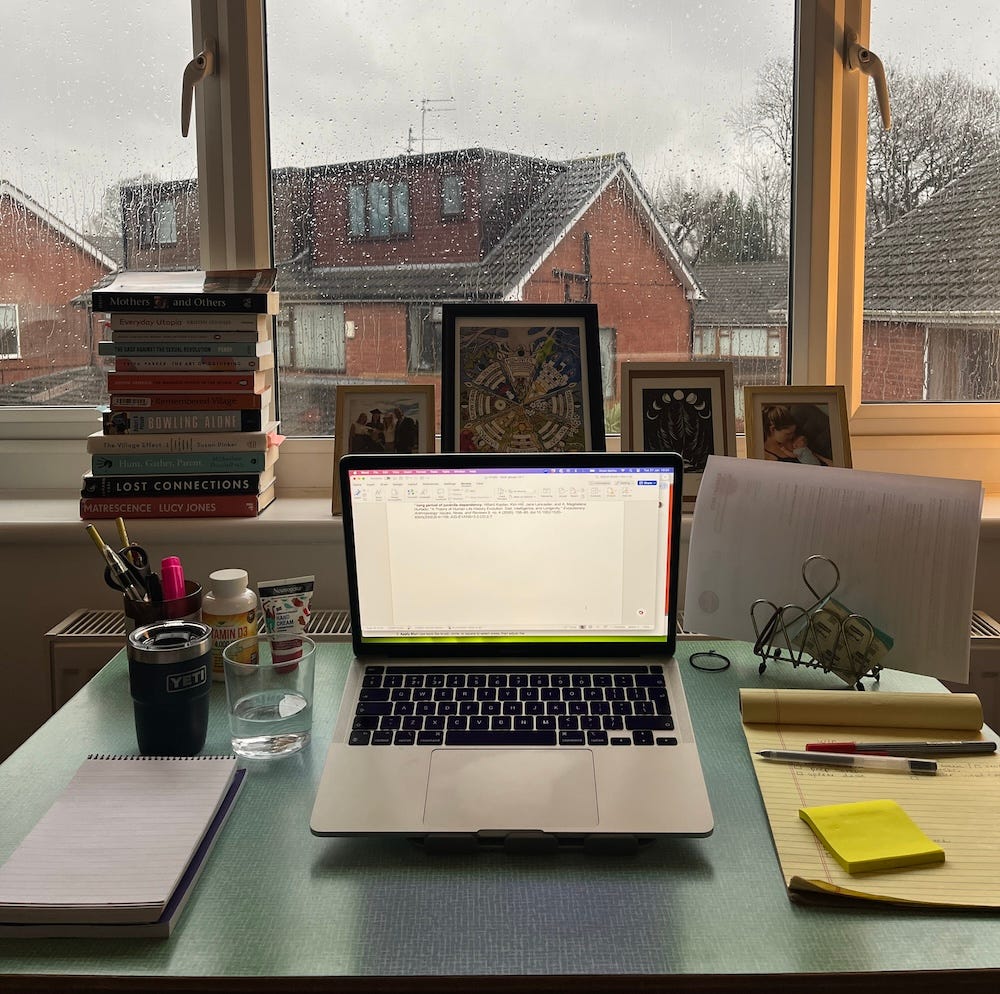
I have planned for some time to send an update of my book-writing process. All being well, I’ll be turning in a full manuscript just as this long, cold winter turns to spring, having written the first draft in just shy of 10 months.
Each time I think about what I want to share about this process, I worry it will sound like I am writing on a mountaintop, in perfect creative flow, bringing my vision to life without being totally torn up by what’s going on down on the ground. I worry I will sound like those insufferable people who post their enviable morning routines, all soaked chia seeds and ceremonial matcha, rather than my personal reality of being woken up at 5:50 am every single day by a three year old committing some act of destruction.
Here’s what I’ve learned: A book isn’t something you write so much as you live. The project has to be metabolized alongside your life, shaping you as much as you shape it. There are countless disruptions and frustrations that block your progress, especially if you are a caregiver. And then there are the unrelenting heartbreaks of our era, and the looming question of what the world will look like when the book you are writing is actually released into it. In many ways, I am writing a book called How To Build a Village because that project is literally the only sane response I can think of to the devastating reality we live in. It’s the only thing I can get behind.
One of the questions that I keep asking myself, and feel compelled to articulate in writing, is this: Given the rapidly-changing state of our world, what is the point of writing a book in 2026? Not my book, but any book.
There are a lot of potential answers to this, which would vary based on the writer, the deal they got, and their overall career picture. But money, institutional prestige, brand-building, and reputation might be the leading assumptions. In fact, I find it very curious that people who don’t write (or even necessarily read) still seem very impressed when you tell them you are writing a book that will be released by a major publishing house. For whatever reason, in our relentlessly digital world, the physicality of a book still holds a lot of psychic weight for people.
While the tangible and durable nature of a physical book does appeal to me, these aforementioned things really aren’t my primary motivators. There are, after all, a lot less painstaking and unpredictable ways to earn a living, and if I cared about prestige I probably shouldn’t have quit my full-time journalism job six years ago to write on Substack.
So why else do it? Why not publish my book in parts on Substack? Or just enjoy my life and do work that doesn’t require me to sit at a laptop for way too many hours and to hasten by eyesight’s precipitous decline. This question becomes particularly urgent in the AI slopscape, where some days, the very idea of being a writer at all starts to feel silly at best and precarious at worst. When people can barely watch a two minute video and agree what they see anymore, let alone parse an author’s argument through 80,000 words of text.
This also weighs on me because the topic of building a village, of that exact term, has kind of exploded in the discourse since I got my book deal back in June. This is both thrilling and terrifying for me. Of course, this idea is not mine and mine alone! But every day I see Reels, and TikToks, op-eds, and Substack posts that are knocking on my book’s door — some of them using strikingly similar language to things I wrote several years ago, probably because AI helped write them. I would be lying if I said these bite-size pieces of content, in aggregate, don’t cause me stress. How will I make sure my book both transcends and folds in all this discourse? Will anyone still care?
There was a great piece doing the rounds on Substack last week entitled Text Is King. I entered into it cautiously, feeling a little too buried to be willing to have my mind changed by counter-intuitive interpretations of graphs and statistics.
But the author, Adam Mastroianni, convinced me. He writes:
Finishing a great nonfiction book feels like heaving a barbell off your chest. Finishing a great novel feels like leaving an entire nation behind. There are no replacements for these feelings. Videos can titillate, podcasts can inform, but there’s only one way to get that feeling of your brain folds stretching and your soul expanding, and it is to drag your eyes across text.”
You should read the full piece, because he presents the argument of why nothing can replace text in various compelling ways. (A+ for the Devil Wears Prada reference.) But the image of brain folds stretching and souls expanding captured why I’m doing this.
It sounds grandiose, and in a way writing a book is just that. You need a kind of delusional belief in your ability to present an argument in a way that’s compelling enough to hold a reader through many hours of their life. You have to sustain an intense level of focus while you live your whole life, in all its maddeningly complexity, with all of the world’s heartbreak happening around you. You have to believe in it that much.
I realized last week that what I’m arguing in my book — that it’s worth it to double down on the friction of other people, because we’re designed to do it, it’s how we thrive, and it gives life a meaning and purpose that is vital to surviving this moment — has a corollary in the act of actually writing the book. I have to convince myself, over and over, that it’s worth it to double down on the tedium of trying to capture my own personal transformation in the form of book — rather than a TikTok or Substack or podcast — because the particular work of doing that stretches and expands me in ways that are surprising and challenging to myself.
And to Mastroianni’s point, there is something that happens in that years-long process of expansion — in the thinking, the reporting, the writing, the editing, and indeed the living — that cannot be replicated in another more convenient or instantaneous medium. The long period of gestation isn’t an inconvenience to the finished project, it’s the very reason the finish project may have an impact. Ultimately, I hope that reading about my own transformation will feel pleasantly stretching for you, that it will metabolize alongside your own experience, and perhaps catalyze a similar transformation in your own life. That is the reason I read books, and I’m finding, it’s the same reason to write one.
So that’s it for now. Far from being on top of a mountain, I am deep, deep in the hole, and I will be here for a while longer. I’ll let you know when I make my way out.
How we got here
Some of you are new(er) here, so I thought it might be a good idea to re-up some of the pieces that led to the book I’m writing. Reading them in order is kind of interesting, because you can see my own internal progression as I figure out what I’m trying to say.


I’m hiring a fact checker
I’m very excited to be able to hire a fact checker to help refine the book in early spring. I hoping to find someone with with prior fact-checking and/or editorial research experience who is ace at navigating academic articles, specifically in the behavioral sciences (anthropology, psychology, sociology). You won’t be checking the entire manuscript, but sections and portions I need particular help getting right. Of course, it’s paid — not by the publisher, but by me. You should know that I am a former magazine fact-checker, and wildly pedantic when the occasion calls for it, so you definitely need to share these obsessive qualities.
If this sounds like you (or someone you know) please email me with “fact checker” in the subject line so we can talk. rosiespinks [at] gmail [dot] com
Workshop
There are a lot more people who are dipping their toe into freelance work, side hustles, creative portfolio careers etc. Back in November, I mused on Substack Notes about offering another workshop for paid subscribers surrounding the “soft skills” that are becoming even more important in the AI era.
It’s going to take place on Substack Live on Thursday, February 19 at 7pm GMT. I’ll offer my own best practice when it comes to outreach, reporting, asking for interviews, collaborations, following up etc. In other words, how to attain the right blend of politeness, flattery, persistence, authenticity, and organization to ultimately get what you want (an interview, a yes, an answered email, a collaboration) without looking like a maniac.
I honed these skills as a reporter, and they prove useful to me every single day. They are the stuff AI really can’t teach you — and I notice a lot of people need them. The workshop will be very granular and specific, so you’ll come away with all my secrets from 15 years of working for myself.
It will be recorded and sent to paid subscribers (along with my accompanying notes) after the Live. If you want access, all you have to do is upgrade to a paying subscriber any time before February 19th. If you upgrade, you will also get access to my workshop from last summer: How to get your words out of your head and onto the page.
Thank you for reading. All of my writing here is offered free to all readers, but if you want to support my work further, you can upgrade to an annual paid subscription here.
There will always be a contingent of us who will rely on the human to human connection that a will written book will provide. I believe that contingent will grow as people realize their souls needs more than information. There’s an alchemy that happens when someone is able to pull gold out of all that information in a novel, unexpected way. Go do that. We’ll be here.
Having just finished my own book (a process that took ~3 years…not to mention some major pivots—from writing about fun to writing about death, lol), I am so touched to read about your own writing journey (and be directed to Adam Mastroianni’s work). I relate to the need for a kind of “delusional belief,” the intense focus required, but more importantly, to how the process of taking on such a project itself begins to change you (in particular, I feel practically allergic to short form content or basically anything that has been created hastily). Anyway, good luck with this next stage. As a fellow mom to a young child who is also struggling to build a village far away from “home,” I’m eager to read the final product!