

On not doing stuff to my face
Choosing the creature over the machine

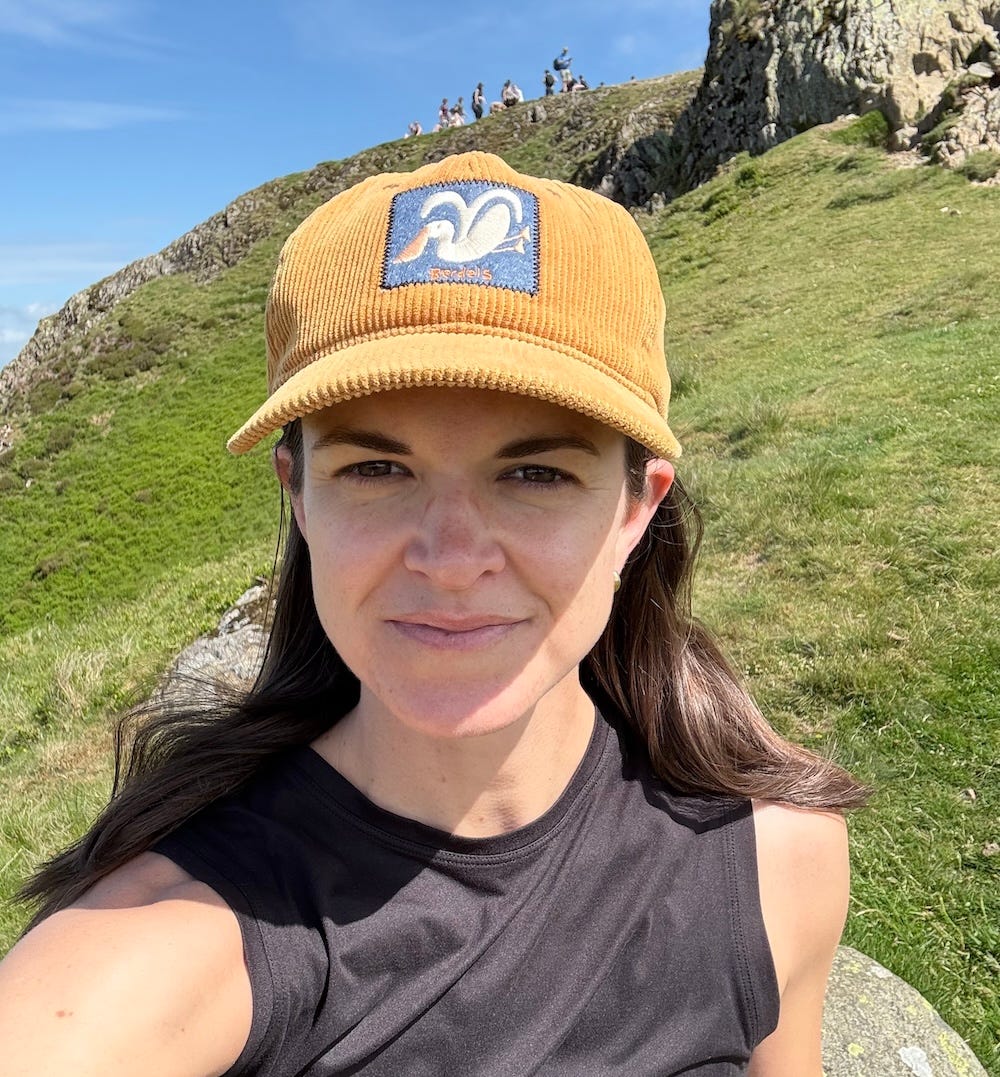
A few months ago, someone asked me to provide a photo to accompany a short Q&A interview I’d done. I sent a selfie I’d taken more than a year before, of me sitting on the bench outside of my house, squinting into the sun.
When the piece came out, a caption had been added to the photo. It complimented my refreshingly natural face and complexion. In other words, the face of a person who plainly does not look like she’s in her early 20s anymore.
I have no doubt that the person who wrote the caption meant it as a compliment. With some focused mental effort, I managed to take it as one. But this fleeting piece of internet content represented a shift for me: One where I realized that my decision to not inject things into my face isn’t just a personal preference anymore, or the default state of being a human. My face is now a stance that other people can see I am taking, without me saying so.
There are a million essays justifying why women do or do not choose to inject things into their faces, and I’ve resisted the urge to add to this particular genre. It’s too often cloaked in feminist language that, at this point, means absolutely nothing to me. It’s also a topic rife with contradictions and hypocrisy. I spend roughly four minutes putting make-up on my face most days and I use retinol — why am I drawing the ethical line at neurotoxin?
But there is a creeping feeling in life these days that if you don’t acquiesce to how fast everything’s changing, if you don’t sign up whole-heartedly to the myth that everything can get better and faster and greater and younger forever, then you are a fucking loser. Reese Witherspoon is in my algorithm telling me in her chirpy feminist lilt that ladies like me better learn to use AI, lest we get left behind by the big powerful rich guys. Using AI is feminist now, actually! Just like botox!
The writer and conservationist Wendell Berry once wrote1 that “it is easy for me to imagine that the next great division of the world will be between people who wish to live as creatures and people who wish to live as machines.” He wrote those words in 2000, and they remain a crude yet helpful rubric with which to assess the many choices we’re faced with a quarter century later.
I have spent much of the last year or so with a sense of disorientation — some days it veers into an acute feeling of grief— when I observe how few people seem to realize what they are giving up when they choose the machine over the creature. I watch people go along with this or that, without giving one single thought to the value systems, incentive structures, and trade-offs that accompany it.
I’ve spent a staggering amount of time thinking about where this leaves me. Who am I now? Am I too sensitive? Am I actually the crazy one? Why do I sometimes feel like the only person who doesn’t want to go the way of the machine? And how did this happen so quickly?
By the standards of optimizing aesthetics to help succeed in the machine, botox is, at this point, incredibly passé. We’re living in the “age of the needle,” as The Atlantic recently put it. You can get injectables in a strip mall on your lunch break now. “Baby botox” is marketed to 20 year olds as preventative. And now that the masses can afford to smooth their foreheads and delete their eleven lines, the rich have moved on to deep plane facelifts. The result of the latter being the ubiquitous “forever 35 face” that makes people look very hot, yes, but also vaguely anaesthetized.
Which is why I write this now: Whereas once a woman may have written an essay defending her right to botox, it now feels more urgent, at least in my social milieu, to do the opposite: Defend one’s choice not to.
***
Most of the people I see in the world as I walk around each day have not injected things into their faces. The writer Haley Nahman wrote a great piece where she did some back-of-the-napkin math to put forward the encouraging idea that “96% of adult women in America are not getting Botox.”
And yet, the faces (real and AI-generated) that we’re relentlessly served in the algorithm, the advertisements and sponsored content paid for by pharmaceutical and beauty companies, the articles in the increasingly billionaire-owned media, the celebrities and influencers who sit atop our visual and popular culture tell us otherwise: Everyone is doing it.
In her piece, Nahman calls this the botox psyop: “Our impression of what ‘everyone is doing’ shapes our view of society at large, and by extension, our place in it.” she writes. The perception is that the choice has been made for us. Witherspoon was using the same tactic in her now-viral (and much maligned) AI video: use it, or risk irrelevancy.
The truth is I sent that year-old selfie to accompany the Q&A because I didn’t have many other options to choose from. Once I had my son at 32, and realized that exhaustion is not just a newborn phase thing but a baseline norm of modern parenthood, I basically stopped taking pictures of myself unless my son is also in them.
My camera roll has loads of these — his ebullient youth right next to my face, justifying my exhaustion. I wonder how much of my gradual reluctance to show my face online over the last half decade is because of the psyop itself. Because my natural age, at just 36, has already parted ways with what the machine wants. And even though I am committed to the side of creature, I have still internalized the idea that actually looking like one means I should hide myself away.
In pieces like this one, there is usually a disclosure that good feminists (meaning ones who presumably don’t want to get cancelled) include. They say something along the lines of: While this is my choice, everyone has the right to choose what they want to do with their own body. In other words: Don’t worry! I’m not judging you!
So sure, everyone has the right to do what they want with their own body. But I’m done pretending that the choice to participate in all of this is neutral, that it doesn’t extend beyond the individual. Nor do I think it’s remotely intellectually honest to frame the choice as somehow feminist.
Botox can be a useful adaptation2 to a patriarchal system that harms women (and men) by saying the former is only valuable when they are young and hot. I do understand why some women choose to make that bargain — it’s hard maintaining one’s principles in this economy. But we have to acknowledge that by doing so, we have, in about a decade or so, shifted botox from something that 45 year old women consider doing to something that 25 year olds do.
This direction of travel is not, as Tressie McMillan Cottom put it, a “positive societal indicator.” It’s the psyop working exactly as it was intended to.
***
Writing the first third or so of my book — about how we lost the ancient piece of human infrastructure that is the village — made me think a lot about the opportunity costs of modernity. Capitalism has taught us we can have it all. If we take the pill, or buy the thing, or move across the world for an opportunity, we can inexorably improve our existence with no discernible downside. It’s a fairly banal point, but it’s remarkable how infrequently we say it out loud: By investing in one pursuit, one set of values, one path, we do so at the exclusion of another. We cannot actually have it all.
I don’t deny that I would look better with botox. I would love to notice my forehead and smile lines less on Zoom calls (I actually got bangs cut in a year ago to help with this.) But despite that, I’m acutely aware of what I will give up the moment I sign onto injecting things into my face to look younger, presumably for the rest of my life: money, time, headspace — all those things, yes. But also the belief in my own inherent goodness. A sense of freedom. And above all, my deep, embodied sense that I am connected to everything and everyone, in a elegant cycle of life and death, growth and decay, expansion and contraction.
What I am seeking is not success in the machine, but liberation from it. I’ll admit that it is hard to eke out, even in small pockets, and there are all kinds of ways that I still lose the battle. But injecting something into my face, which constrains my ability to fully express myself, and has no other discernible benefit but to make me more attractive to an extractive system that profits off my own feelings of inadequacy? I just can’t find a way to justify it to myself.
I fear it’s cliche at this point to say I want my face, my body, my very being to be a record of the life I’ve lived, the wisdom I’ve attained, the fucks I no longer have the energy to give. But it’s true. I want my nature as a creature to remain legible and visible to other people, if only faintly so, as a kind of permission slip. Because one day, maybe long after I’m gone, the machine will run out of fuel. And people will have to go looking, to remember how to exist in another way. And I think the creature will still be there, doing what it’s always done, sustained all along by its irrepressible, renewable nature.
Thank you for reading. All of my writing here is offered free to all readers, but if you want to support my work further, the cheapest way is to do that is to upgrade to an annual paid subscription here. Thanks to those of you who already pay to support my work — it gives me the time, childcare, and headspace to write essays like this one.
This appeared in Berry’s 2000 book, Life is a Miracle: An Essay Against Modern Superstition. I came across it more recently as the epigraph to Paul Kingsnorth’s similarly themed book, Against the Machine: On the Unmaking of Humanity
This idea of adaptation came from a conversation I had with the writer and consultant Nicola Washington, in part about showing my face on the internet before my book comes out. I can’t cite it properly other than to say it helped lead to this essay.
Thank you for this. I am so annoyed by every take on "tweakments" being accompanied by this choice feminist caveat of "But you do you! Choose whatever makes you feel good!". Because no, digging everyone else's grave a little deeper can never be a feminist act. Of course I can understand when someone chooses to undertake this adaption, as you call it - but we have to acknowledge it for what it is: actively contributing to the system that made you feel like you have an expiration date in the first place.
Some great points. I am 54 and work in work places populated by women in their mid 30s who are all Botox-ing. They come to me for advice on many things and I have to be careful to check my disgust about what they are doing. The biggest thing I want them to understand (but also I get that that is impossible for them to do until it happens) - is the notion that you actually like yourself more as you age. I loved my body way more in my 40s than any other time before. My face in my late 40s was my favourite version of my face ever. Partly due to lessons learned of who I was and what was best for me but also a true understanding of what lights me up. I was at my most natural and most beautiful. Post menopause I have had to deal with some self doubt setting in but also have to remind myself that if it was true that I loved myself as time passed then it would most likely happen again.
I’m so happy I did not have alterations as I would never have gotten to have seen that beautiful me that was growing my whole life.