

On collective effervescence
Notes from an unlikely World Cup fan

A time-sensitive programming note before the short essay below: Sarah Wilson and I finally are going Live on Substack this Thursday at 1pm UK time to talk about her new book on collapse. Scroll down for details…
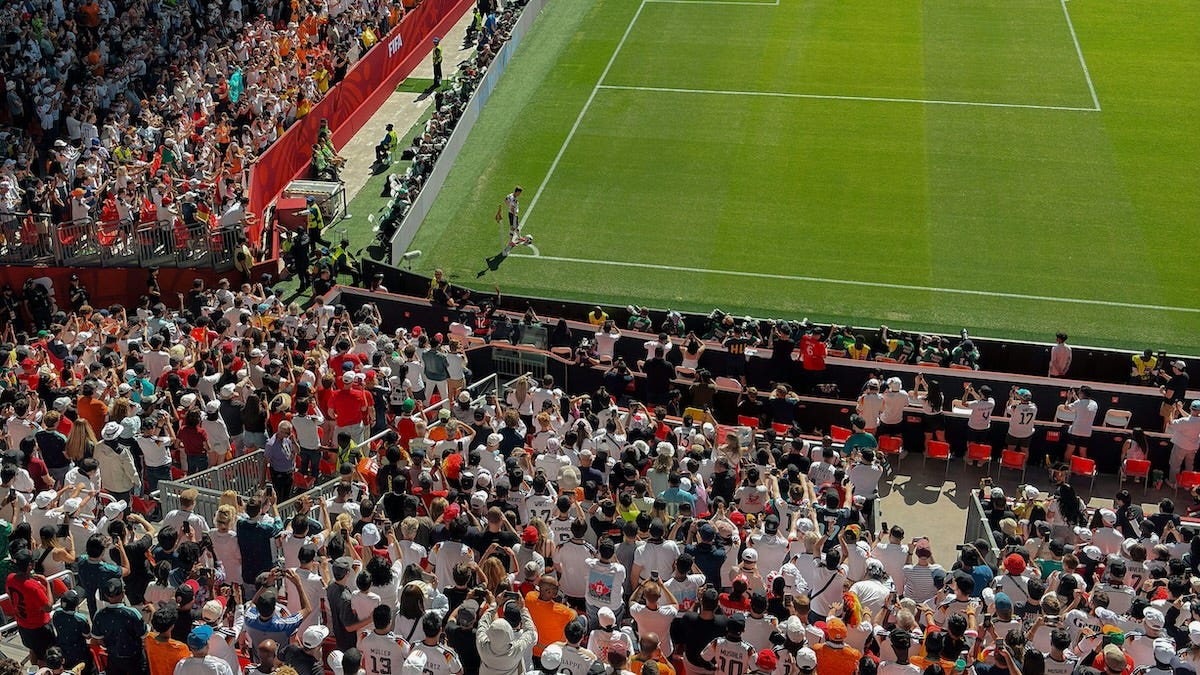
I don’t really give a shit about football. At times in my life, I’ve thought the whole thing is kind of stupid, a way for British men to access deep emotions in absence of any other socially acceptable means.
Alas, I am now married to one of those British men. Despite checking the score of his chosen Premier League team (Liverpool) week to week, he doesn’t actually watch the games. Too much strife. However, he has a policy that I now also adhere to: We pay attention to the Euros and the World Cup.
All of this is to explain how I ended up lying in bed on Monday morning watching the 12 minute highlights of the England vs. Mexico game, which took place at 2am our time. I have never, in my entire life, cared enough to do such a thing. We actually had a terrible night prior — up multiple times dealing with bad dreams and accidents, you know the drill — so the news of a win, served alongside tea, was a balm. In the spirit of deeply-ingrained self defeatism that everyone in England must share, I had resigned myself to the idea that there was no possible way we were going to beat Mexico on Mexico’s high-altitude turf.
But beat them we did. And though football certainly has its beautiful moments of athleticism, it’s not actually the game I’m interested in — but rather, the paroxysms of celebration that follow. I just cannot get over the unhinged joy of a bunch of blokes belting Wonderwall together in a stadium halfway across the world. Or chanting Hey Jude to lionize Jude Bellingham at 4am in a pub. The joy and belonging contained in that act. The hope and the triumph. At this particular moment in time, it feels, to me, like an antidote to everything that’s bad. I could watch it all day.
This, after all, is who we are. As I learned reporting my book, some evolutionary anthropologists call this the “social toolkit,” a range of behaviors build trust and cooperation with lots of people at once, because they feel very good when we do them: chanting, singing, dancing, cheering among them. The French sociologist Émile Durkheim had a similar term for this, “collective effervescence,” or that buzzy feeling you get when united with a crowd in a shared aim.
In addition to being fun, it’s a huge evolutionary advantage, and part of the reason we are so profoundly pro-social, and therefore so demographically successful as a species. There’s there’s a catch, though: it only works if we do it in person. There are scientific reasons for that, but for now suffice it to say: We are not just made of brains, but also bodies and spirits.
The author Jon Haidt has been posting on similar lines on his Instagram recently: videos of people chanting, singing, emoting together in shared collective space. (Here’s one of a spontaneous Star Spangled Banner sing-along on the NYC subway. I dare you not to smile.) Last Friday, there was a music festival at the large park near our house. I met a friend at the pub with our kids for dinner and, ahead of Pitbull’s set, everyone was walking around our corner of north Leeds in bald caps and suits and ties. It was so dumb! So silly! People were so amped for Mr. Worldwide! I didn’t go to the gig, but I felt effervescent all the same.
This is the type of stuff that many of us are missing from our lives: shared experience in a defined space. We used to get it from church or temple, from seasonal rituals, from dancing at the village fête. And we used to do it often enough that most of us still inhabited the same baseline reality about the state of the world.
The feeling these kinds of experiences provoke is one that doesn’t serve those in power. We’re incentivized to give it up because we generate more value at home on our devices, asking inane questions to an LLM, outsourcing all tasks, mistrusting our neighbors, needing one another less and less so we buy more and more.
FIFA is making a boatload of money from the World Cup, to be sure, but the emotion that the game stirs up, the shared history and identity that it denotes, feels, in England at least, like it touches somewhere deeper than profit. And I think the reason it is so delightful to watch is because the enormous spectacle of it reminds us that that is available to us.
I can say with some authority — because I’m very nearly done writing an entire book about it — that we have to work a bit harder to both seek out and create the experiences that give us that feeling now. But they’re still there, I promise you. We don’t need data or peer reviewed studies to prove it. We just have to leave the house.
And sure, you could reasonably argue that this football hooliganism often goes too far, and that the extreme version of what I’m romanticizing here looks like ugly forms of nationalism or tribalism or whatever. But I just don’t have it in me to problematize or overthink it this week. It just feels good. So I’m going to sing along. Come on England. 🏴 💪
Sarah Wilson on collapse and how to live now
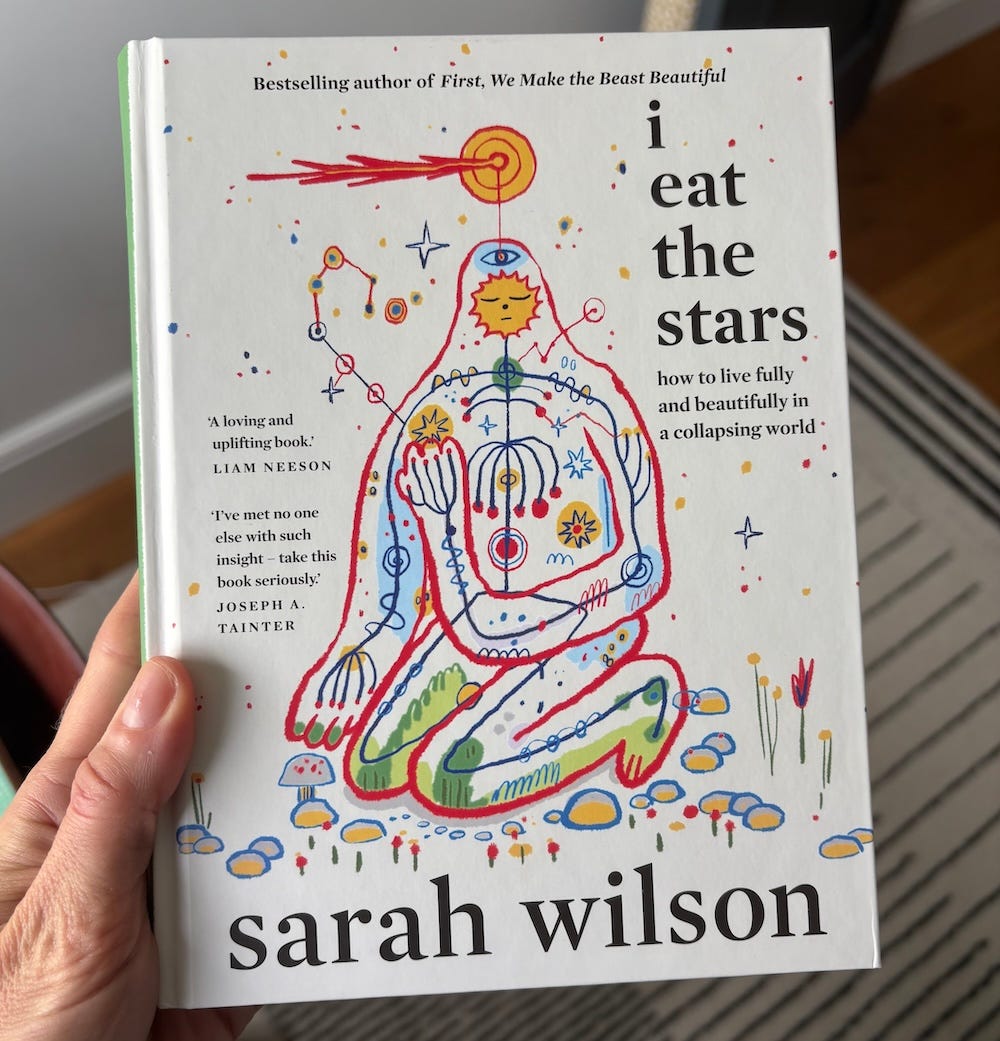
I’m so excited that Sarah Wilson will be joining me on Substack Live this Thursday July 9 at 1pm UK time (that’s 8am EST and 2pm CET). We’re going to be discussing her book I Eat the Stars, about how to live beautifully in a collapsing world.
I’ve admired Sarah’s work for a long time — even in the days before Substack, in fact! So I’m really looking forward to this conversation. Her recent dispatch from the heatwave in Europe is a great example of how Sarah understands exactly where we are, and is courageous enough to tell the truth about it.
To join, look out for an email in your inbox just before the event starts. Or simply open Substack in your browser or app at the start time — you’ll be prodded in your notifications tab or in the app to join. If you miss it, or your time zone doesn’t allow, I’ll post a link to the recording in the few days after.
Thank you for reading. All of my writing here is offered free to all readers, but if you want to support my work further, the cheapest way is to do that is to upgrade to an annual paid subscription here. Thanks to those of you who already pay to support my work.
THIS! Watching the World Cup is an ethical struggle but I choose to focus on the stories of the players and countries. I love how this connects to the bigger picture of community and collective!
Love this Rosie! I'm the same, zero interest in football the rest of the time but boy do I love to watch a big crowd of people sing and hug and cry.